
Steroid Injections
A steroid injection (often referred to as a cortisone injection) delivers a dose of corticosteroid medication directly into a specific joint or soft tissue area
A steroid injection (often referred to as a cortisone injection) delivers a dose of corticosteroid medication directly into a specific joint or soft tissue area
A steroid injection (often referred to as a cortisone injection) delivers a dose of corticosteroid medication directly into a specific joint or soft tissue area.
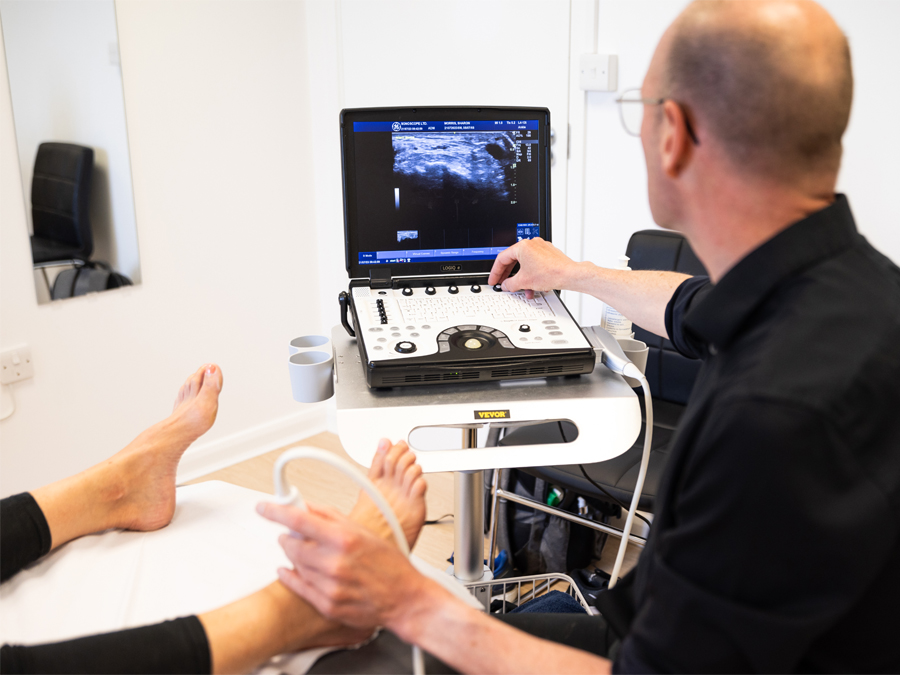
We use ultrasound guidance for our injections. Unlike “blind or landmark guided” injections (where the operator feels landmarks on the skin), ultrasound allows us to see the needle inside the body in real-time.
The skin over the injection site is thoroughly cleaned with an antiseptic solution to minimize infection risk.
The clinician applies an ultrasound gel and uses an ultrasound probe to visualize the target structure (joint, bursa, or tendon sheath) and identify any nerves or blood vessels to avoid.
Watching the screen in real-time, the clinician guides a fine needle precisely to the target area. Because we can see exactly where the needle is going, we can often avoid sensitive structures, making the procedure more comfortable.
The needle is removed, and a small plaster is applied. The actual injection process usually takes only a few minutes.
Research shows that ultrasound-guided injections are significantly more accurate than blind injections. This increased accuracy improves the effectiveness of the medication and reduces the risk of accidental injury to surrounding tissues.
Steroid injections for musculoskeletal conditions do not cause weight gain. Weight gain is associated with oral steroids which are often taken regularly in tablet form. Injectable steroids when done for musculoskeletal structures do not have a weight increasing effect as the injection is specifically targeted to an anatomical structure (joint, bursa, tendon sheath etc.) the dosage is appropriate for the size of the structure injected which generally means that it is not higher than 40 mg of Depo Medrone. This dosage is limited and only administered as a one off and therefore will not result in any weight gain.
Localized Changes
Serious complications are rare, especially when performed under ultrasound guidance by a qualified clinician. However, you should be aware of the following:
Steroids are used to reduce inflammation and pain. Ultrasound guidance provides precise delivery thereby reducing potential side effects and potentially increasing the likelihood of benefit.
Procedure information downloads and consent form.
Please click the button below to complete our clinical information and injection consent form before any treatment takes place.
Expert musculoskeletal specialists offering fast access, accurate diagnosis, and precise pain relief, trusted by patients across.