
Ultrasound-guided Injections
An ultrasound guided injection is a minimally invasive procedure
used to treat various painful musculoskeletal conditions such as tendonitis, bursitis and neuritis.
An ultrasound guided injection is a minimally invasive procedure
used to treat various painful musculoskeletal conditions such as tendonitis, bursitis and neuritis.
An ultrasound guided injection is a minimally invasive procedure used to treat various painful musculoskeletal conditions such as tendonitis, bursitis and neuritis. Guided injections can be used to perform cyst aspiration as well as to guide the placement of needles for both diagnostic and therapeutic purposes Injection of pain medication with a local anaesthetic directly to the site of injury to help relieve pain.
The advanced imaging of the ultrasound provides high-resolution images that enable your physician to precisely locate the injections deep into the target tissue without harming surrounding tissues.

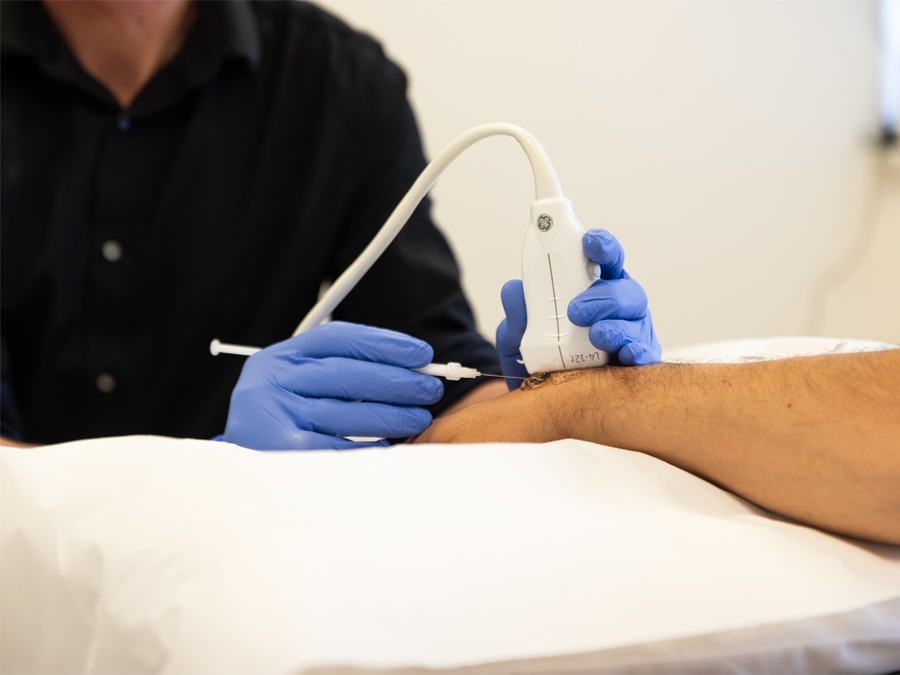
High-resolution ultrasound guidance during injection procedures dramatically increases their safety, since the injections are accurately targeted to the treatment site.
There is a plethora of research studies concluding that ultrasound-guided needle procedures significantly enhance patient safety and quality of care. At the same time, ultrasound-guided procedures eliminate complications that can arise from “blind” needling therapies and injections.
Expert musculoskeletal specialists offering fast access, accurate diagnosis, and precise pain relief, trusted by patients across.
Ultrasound-guided injections are a major advancement over traditional “blind” or “landmark” guided injections. Ultrasound-guided injections use real-time ultrasound guidance with the needle being directly visualised by the operator allowing for pinpoint accurate targeting of musculoskeletal structures. This produces several advances over the unguided injections especially regarding the accuracy, safety and the diagnostic clarity.
There is a good body of evidence that indicates that ultrasound-guided injections are much more accurate than unguided/landmark guided injections. Accuracy rates for ultrasound-guided injections are above 90% whilst for many unguided injections the accuracy rates are much lower, usually in the 70% region but in some cases as low as 40%.
Overall ultrasound-guided injections provide better outcomes when compared to unguided injections. For some easily accessible areas the differences might be small. However, ultrasound guidance offers more significant differences in hard-to-reach joints like hip joints as well as tiny joints like the hand and foot and other regions with intricate anatomy.
If an unguided injection was not beneficial due to inaccuracy the patient might require a repeat injection whereas if the injection had been carried out under ultrasound guidance to start with the likely need to repeat the injection would be significantly less.
By visualising the needle in real-time the clinician can avoid structures such as nerves and blood vessels and other organs which significantly reduces the risk of accidental puncture of these structures making the procedure significantly safer. The clinician can also verify that the injected substance has been accurately deposited by seeing it within the target structure.
The accuracy of the needle placement also allows the injector to avoid pain sensitive structures making the procedure much less uncomfortable.
Harmful exposure to radiation such as this used with fluoroscopy of CT-guided injections is not necessary, as the ultrasound waves used are not harmful.
Dynamic examination whilst performing ultrasound scan can help to guide the injection more accurately, as the exact source of pain can be identified during movement.
Aly, A.R., Rajasekaran, S. and Ashworth, N. (2015). Ultrasound-guided shoulder girdle injections are more accurate and more effective than landmark-guided injections: a systematic review and meta-analysis. British Journal of Sports Medicine, 49(16), pp.1042–1049.
Cunnington, J., Marshall, N., Hide, G., Bracewell, C., Isaacs, J., Fenwick, P. and Kane, D. (2010). Ultrasound versus anatomic guidance for intra-articular and periarticular injection: A systematic review. Arthritis Care & Research, 62(7), pp.969–977.
Fang, W.H., Chen, X.T. and Vangsness, C.T. (2021). Ultrasound-Guided Knee Injections Are More Accurate Than Blind Injections: A Systematic Review of Randomized Controlled Trials. Arthroscopy, Sports Medicine, and Rehabilitation, [online] 3(4), pp.e1177–e1187. Available at: https://www.ncbi.nlm.nih.gov/pmc/articles/PMC8365196/.
Hoeber, S., Aly, A.R., Ashworth, N. and Rajasekaran, S. (2016). Ultrasound-guided hip joint injections are more accurate than landmark-guided injections: a systematic review and meta-analysis. British Journal of Sports Medicine, [online] 50(7), pp.392–396. Available at: https://pubmed.ncbi.nlm.nih.gov/26062955/.
Maricar, N., Parkes, M.J., Callaghan, M.J., Felson, D.T. and O’Neill, T.W. (2013). Where and how to inject the knee—a systematic review. Seminars in Arthritis and Rheumatism, 43(3), pp.384–393.
Soh, E., Li, W., Ong, K.O., Chen, W. and Teh, J. (2011). Image-guided versus blind corticosteroid injections in adults with shoulder pain: a systematic review. BMC Musculoskeletal Disorders, [online] 12(1). Available at: https://bmcmusculoskeletdisord.biomedcentral.com/articles/10.1186/1471-2474-12-137.