
Iliopsoas tendinopathy / bursitis what is it?
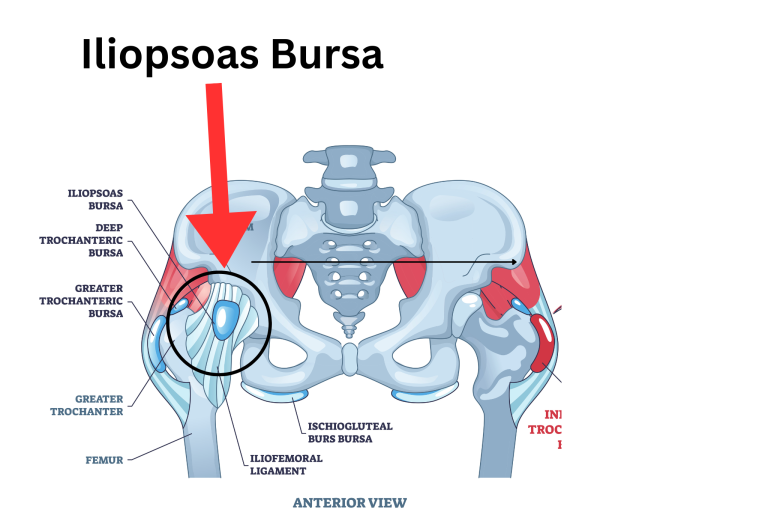
Iliopsoas tendinopathy affects the iliopsoas tendon which is an important hip flexor and stabiliser muscle attaching to the lumbar spine and pelvis as well as the femur (thigh bone).
When the tendon becomes irritated and inflamed it can swell up and become chronically inflamed and irritated which we do call a tendinopathy. This problem usually occurs due to repetitive activity which can include running. In the process it can also cause inflammation to the bursa which is small fluid sac that is normally almost empty and lies adjacent to the tendon but can then swell up and become painful which is called an iliopsoas bursitis.
Ultrasound-guided steroid injections can be very useful in specifically targeting this tendon and/or bursa. This of course is to get pain levels under control and once symptoms have diminished then further physiotherapy input and/or other conditioning work is very important to obtain long-term improvement.
What are the symptoms of Psoas Tendinopathy/Bursitis?
Symptoms can vary but usually symptoms have the following components:
- Pain that is felt over the anterior hip area. Oftentimes this is a deep ache but in other cases it could be very sharp pain.
- A clicking or snapping sensation. As the tendon moves over the inflamed hip/bursa sometimes a snapping or clicking sensation can be noticed during movements.
- Due to significant pain there might be limitation in range of motion of the hip as well.
- In almost all cases there is a very specific local pain area that patients often time can point to by pressing on it.
Conditions that can be confused with Iliopsoas Tendinopathy/Bursitis:
There are a number of other conditions that can also present as iliopsoas tendinopathy or bursitis. Please see below a number of common conditions that can refer pain in his region:
- A deep aching pain in the groin area is often common in people with osteoarthritis of the hip joint.
- Disorders of the lumbar spine such as spinal stenosis or a herniated intervertebral disc can also refer pain in the anterior hip region.
- Other conditions such as Gilmore’s groin (sports hernia) or adductor tendinopathy can also present with pain in this anterior hip region.
- Pain at the more lateral aspect of the hip (at the side of the hip) is often due to greater trochanteric pain which is related to gluteal tendon insertional tendinopathy or greater trochanteric bursitis.
What are the main causes of iliopsoas tendinopathy/bursitis?
Iliopsoas bursitis and iliopsoas tendinopathy are relatively uncommon conditions. In clinical practice when people present with anterior hip pain this condition is over diagnosed. Very few people after further investigation (ultrasound or MRI) appear to have genuine iliopsoas tendinitis or bursitis.
- Overuse and repetitive activities are one of the main two causes of iliopsoas bursitis. Activities such as running kicking sports such as kickboxing cycling can all cause inflammation.
- The main other category is that of joint specific conditions such as osteoarthritis, rheumatoid arthritis which due to enlargement and osteophyte formation can cause irritation of the iliopsoas bursa and tendon.
How is iliopsoas tendinopathy/bursitis diagnosed? (How do I know that I have iliopsoas tendinopathy/bursitis?)
Clinical examination alone (examination of the hip looking for range of motion in the hip strength of the hip musculature and also local palpation of the painful area) is not enough to come to the definitive conclusion of iliopsoas tendinopathy or bursitis.
Further imaging is required to get more definitive clarity on a diagnosis.
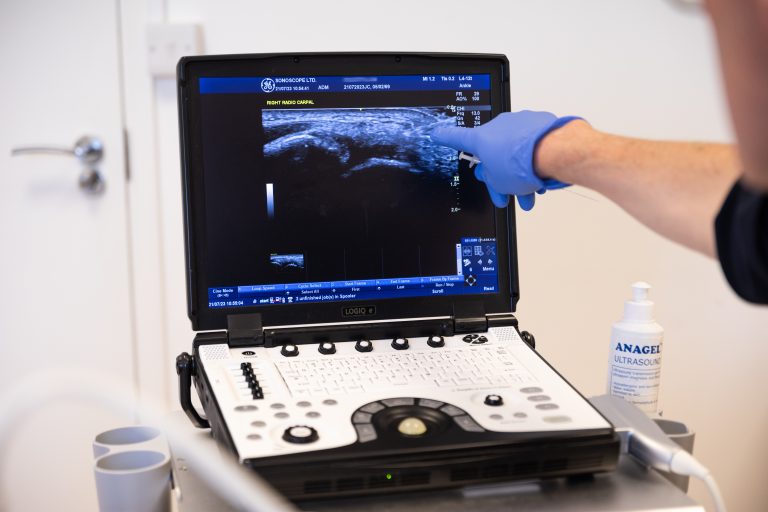
Diagnostic ultrasound
Is often very helpful to identify features of osteoarthritis. It of course can evaluate in detail the iliopsoas tendon itself and any bursitis that might be there as well as other tendon and muscle structures in the region.
At Sonoscope you will not only receive a detailed clinical examination but in addition to that a diagnostic ultrasound all within the same session which Is very important to come to a diagnosis.
X-rays
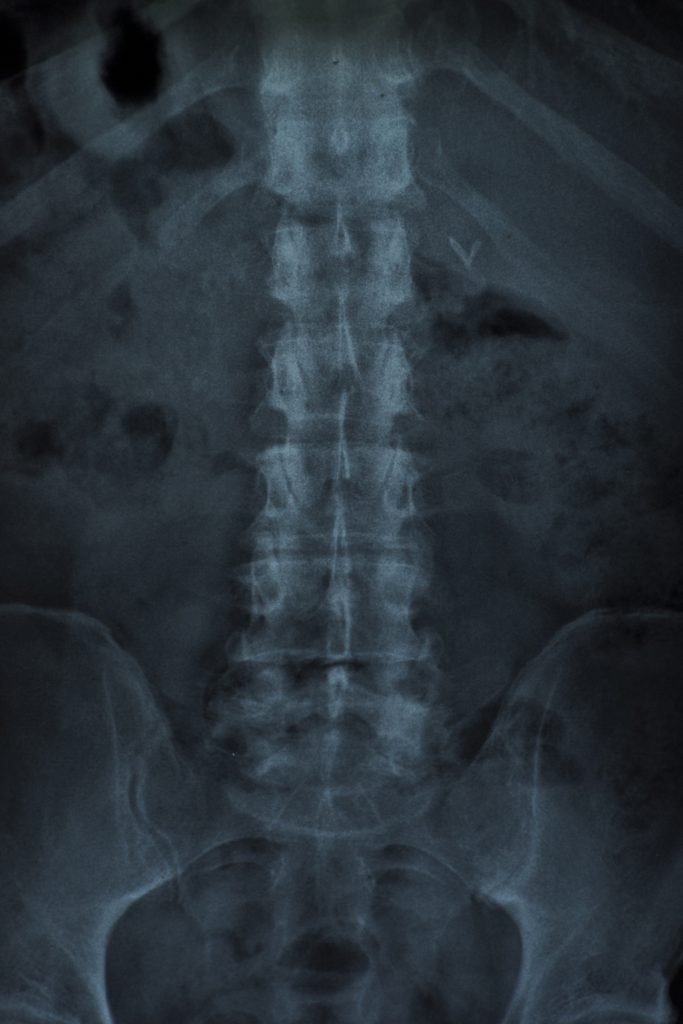
Can be very helpful to identify degenerative changes such as osteoarthritis where x-ray is very helpful for as it is very good depicting bone and can demonstrate any narrowing of the joint space which indicates lack of cartilage and through that the degree of degenerative changes that are present in the hip.
MRI imaging
As the hip joint is a complex three-dimensional structure and in the femoral head is in the deep socket (the acetabulum) is therefore difficult to evaluate the structure deep within the socket.
MRI is very good as it takes multiplanar images at very small slices which is very sensitive in evaluating soft tissues such as the labrum muscles as well as tendons. Patient has to remain still during the examination which can take half an hour to an hour. Samurai is also very good at evaluating the bone structures as well.
Some of the drawbacks of MRI is that some people find being in a small confined space very claustrophobic and cannot therefore endure being in an MRI scanner. Some people do have existing metal work from potentially from previous surgery and this can cause significant artefact and difficulty in evaluating the tissue surrounding it. Pacemakers can only be taken into MRI scanners that are pacemaker safe which is not the case with every scanner

Ultrasound-guided steroid injection
Ultrasound-guided steroid injections are very accurate when targeting structures such as iliopsoas tendon and iliopsoas bursitis.
During the procedure a small amount of steroid plus local anaesthetic will be injected either adjacent to the tendon or in the iliopsoas bursa. The use of ultrasound guidance also improves the safety of this injection and can help reduce unnecessary pain by avoiding pain sensitive structures. Steroid injections vary in the length of time that they can provide pain relief ranging from a few months to a year or more. Most people will at least get two to three months of pain relief,

At Sonoscope we offer a One-Stop-Clinic. This includes: consultation and clinical examination, a diagnostic ultrasound and if appropriate also an ultrasound-guided injection which in the case of iliopsoas tendinopathy or iliopsoas bursitis is a steroid injection.
For any further information and or if you want to book an appointment then please call us on: 07999 923844 or email us about info at info@sonoscope.co.uk