
So the answer to this question is no.
But it is possible for people to put on weight with long-term steroid use, but this is related to the use of oral steroids (tablets). This does not apply to steroid injections for use for structures such as joints or tendons.
What is the difference between steroid tablets and steroid injections?
Steroid injections used to treat tendon inflammation or joint inflammation are specifically targeted to work at a local level, i.e., at the site of injection and not elsewhere. As the steroid dosage is relatively low, for most musculoskeletal conditions the maximum dosage is 40 mg and the minimum dosage is 10 mg. These dosages of steroids do not have an impact on the overall body metabolism and only have minimal systemic absorption.
In addition to that, we only administer steroid injections under ultrasound guidance, which means that the steroid is targeted very specifically, which further helps to reduce unnecessary spread of the steroid to areas where it is not required or needed.
Steroids such as prednisolone, however, are used for many other conditions, such as autoimmune conditions like rheumatoid arthritis and systemic lupus erythematosus (SLE), as well as inflammatory bowel disease. It is also often used in respiratory conditions such as asthma and COPD as well as part of a treatment regime in certain types of cancer such as leukaemia and lymphoma. For these conditions, steroid dosages are often much higher and taken for longer periods of time, which in some cases can lead to significant weight gain.
Can steroid injections lead to weight gain?
Steroid injections as used at Sonoscope are for musculoskeletal conditions and do not lead to weight gain. As explained above, the dosages are much smaller than those used by people with certain medical conditions that require taking steroid tablets for longer periods of time.
There are a number of studies that have clearly demonstrated that people can put on weight when using steroids over the longer term. One study found that 10.2% of individuals exposed to steroids chronically experienced weight gain of at least 10% or more of their usual weight. The risk was higher for younger people, smokers, women and people on high dosages of steroids (Fardet et al., 2021).
Which steroids do we inject?
Generally for musculoskeletal conditions, mostly two types of steroids are used in the UK: Depo Medrone (methylprednisolone) is the most used steroid, closely followed by Triamcinolone Acetonide (Kenalog). At the time of speaking, Triamcinolone Acetonide (Kenalog) is now discontinued by the manufacturer, and any remaining stocks are expected to be exhausted by early June 2025.
At Sonoscope we inject Depo-Medrone. Some hyaluronic acid products come premixed with steroids already, such as a product called Cingal, which comes with Triamcinolone hexacetonide, a long-acting steroid which is not available to purchase on its own in the UK.
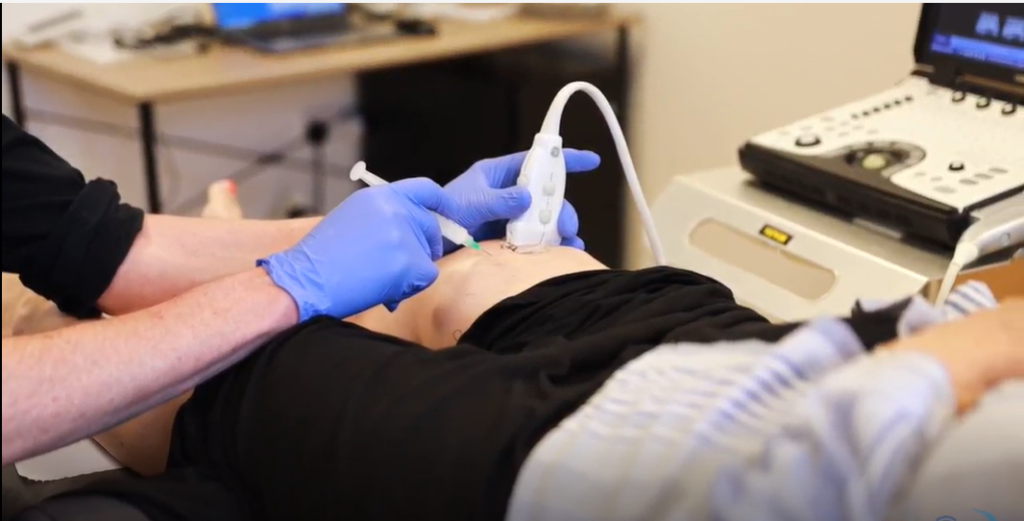
Which conditions are steroid injections generally used for?
Common conditions for which we use steroid injections and sonoscope are osteoarthritis of the knees, frozen shoulder, tennis elbow, carpal tunnel syndrome, etc.
Other common conditions that we also inject are: Trigger finger as well as a number of joints that are affected by osteoarthritis, such as osteoarthritis of the wrist and hand, osteoarthritis of the elbow, osteoarthritis of the shoulder osteoarthritis of the ankle and osteoarthritis of any of the foot joints.
Other conditions that we inject under ultrasound guidance: De Quervain’s tenosynovitis, ganglion cysts around the wrist and fingers. Golfers elbow, olecranon bursitis, subacromial bursitis in the shoulder, trochanteric bursitis at the hip, iliopsoas bursitis at the hip, insertional tendinopathy at the hamstring, Morton’s neuroma at the foot, aspiration of Baker’s cyst at the back of the knee.